
SOC 2, ISO 27001 or GDPR Without Vanta, Drata or Scrut: What Manual Implementation Actually Takes
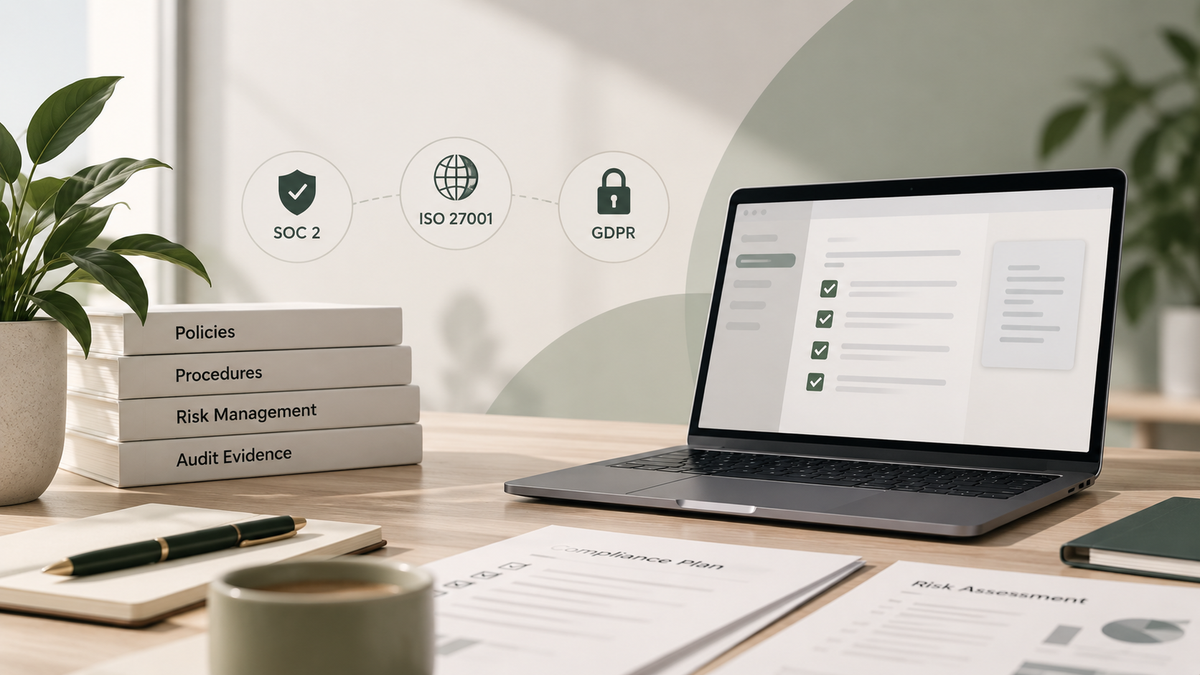
Compliance automation may make the process easier, but it isn’t a requirement for passing an audit. Companies have achieved SOC 2 and ISO 27001 compliance long before platforms like Vanta, Drata and Scrut existed. The real question isn’t whether compliance is possible without these tools , it’s how efficiently you can get audit-ready without letting compliance slow down your business.
Can You Actually Implement SOC 2 or ISO 27001 Without Vanta, Drata or Scrut?
Yes - companies were passing SOC 2 and ISO 27001 audits for over a decade before compliance automation platforms existed. But "possible" and "fast" are different questions, and if a signed enterprise deal or a 200 question security questionnaire is sitting on your desk right now, the gap between the two is where deals die.
This is the question we hear most from seed-to-Series B founders: "Do we actually need Vanta or Drata, or can we just do this manually?" Here's the honest answer, the real timeline, and where a flat-fee compliance consultant fits into either path.
What "Manual" Compliance Implementation Actually Means ?
Without a GRC automation platform, every control in your framework SOC 2's Trust Services Criteria, ISO 27001's Annex A controls, HIPAA's Security Rule, PCI DSS's twelve requirements has to be:
- Mapped by hand - to your actual infrastructure (AWS/GCP/Azure config, HR systems, code repos, vendor contracts)
- Evidenced manually - screenshots, exported logs, signed policies, ticket exports, collected monthly or quarterly
- Monitored without alerts - no automatic flag when an engineer disables MFA or a laptop stops encrypting
- Re-collected every audit cycle - often from scratch, because nothing is continuously synced
For a five-person engineering team with one AWS account, this is tedious but doable. For a Series A company with multiple environments, a distributed team, and customers asking for SOC 2 and GDPR and a PCI DSS attestation, manual evidence collection turns into a part-time job for whoever draws the short straw - usually your CTO or head of eng, at the exact moment they should be shipping product.
The Real Timeline: Manual vs Automated vs Guided
| Approach | Typical timeline to audit-ready | Who does the work |
|---|---|---|
| Fully manual (no tool, no consultant) | 4–9 months | Your internal team, part-time |
| Self-serve automation (Vanta/Drata/Scrut alone) | 2–4 months | Your internal team, using the tool's checks |
| Flat-fee guided implementation | 4–8 weeks | A consultant who's done it 200+ times, using automation on your behalf |
The fastest way to get SOC 2 certified isn't usually "no tool" or "buy a tool" it's having someone who already knows exactly which of the ~60 controls your auditor will actually test and who isn't learning the framework on your dime. Founders searching for the fastest path to SOC 2 certification in 30 days are almost always looking for the third option not the first and realistically, SOC 2 certification in 30 days only happens with a guided, pre-mapped implementation a Type I report with no automation and no outside help closer to the 4 – 9 month range above.
Why Founders Consider Skipping Vanta, Drata or Scrut ?
It's a reasonable question and there are legitimate reasons companies ask about a Drata alternative or a Vanta alternative for startups:
- Cost stacks on cost - A GRC platform subscription runs several thousand dollars a year on top of audit fees and most platforms lock you into an annual contract before you've even scoped what you need.
- The tool doesn't do the audit for you - Vanta, Drata and Scrut Automation are excellent at continuous monitoring and evidence collection but someone still has to write your policies, run the gap assessment, manage the auditor relationship and answer "is this control actually implemented correctly" questions. A compliance automation consultant for Vanta or Drata exists precisely because the software is necessary but not sufficient.
- Small scope, big overhead - A five-person company with one product and one cloud environment can sometimes get through a SOC 2 Type I with a lean manual process and never touch automation software at all.
- Multi-framework complexity - If you need SOC 2 and ISO 27001, or GDPR and PDPA, mapping overlapping controls (there's significant overlap between SOC 2's Trust Services Criteria and ISO 27001 Annex A) by hand with an expert who sees the map already can actually be faster than configuring two separate platform instances.
Where Manual Implementation Breaks Down
The honest failure modes, in order of frequency:
- Evidence drift - Screenshots taken in month one don't reflect reality by month four. Auditors sample across the review period not just at kickoff and stale evidence is the #1 cause of audit findings in DIY implementations.
- Scope creep on controls - Teams over-scope (wasting weeks hardening controls the auditor will never test) or under-scope (missing something core, like vendor risk management and getting flagged mid-audit).
- No one owns it - Compliance becomes a shared responsibility which functionally means no one's responsibility and it slips every sprint planning cycle.
- The auditor relationship - First-time founders often don't know how to scope an audit, negotiate SOC 2 report language or push back when an auditor's request is disproportionate to company size.
This is exactly the gap a fractional CISO or flat-fee compliance consultant is built to close not by replacing the automation tooling but by running the program on your behalf: policies, control implementation, evidence collection and the audit itself so your engineering team stays on product.
A Step-by-Step Framework for Manual (or Guided) Implementation
Whether you go fully DIY or bring in outside help, the sequence is the same:
- Scope the framework - SOC 2 Type I vs. Type II, ISO 27001 certification vs. gap assessment, or a combined SOC 2 + HIPAA audit if you're a healthtech startup handling PHI. Scope drives cost more than anything else.
- Run a gap assessment - Map your current state against every control in scope. This is where a consultant who's done 200+ implementations moves in days what takes an internal team weeks of research.
- Write and ratify policies - Access control, incident response, vendor management, data retention auditors test whether policies exist and whether you follow them.
- Implement technical controls - MFA everywhere, encryption at rest and in transit, logging and alerting, least-privilege access, vendor due diligence.
- Collect evidence continuously not the week before the audit - This is the single biggest reason automated platforms exist and the single biggest reason a guided, disciplined manual process can still work if someone is actually enforcing the cadence.
- Select and manage your auditor - Your consultant should already have relationships with CPA firms that examine SOC 2 reports or accredited ISO 27001 certification bodies, so you're not vetting auditors cold.
- Remediate findings and get your report - A 100% audit pass rate isn't luck - it's not walking into an audit until the gap assessment says you're actually ready.
SOC 2 vs ISO 27001 vs GDPR: Which Framework First?
This trips up almost every founder facing their first enterprise security questionnaire:
- SOC 2 - is the default ask from US enterprise buyers and is report-based, not certification-based - most relevant for SaaS companies selling into the United States.
- ISO 27001 - is an internationally recognized certification, often the default expectation in the EU, Middle East and across Singapore and Malaysia, and increasingly requested by enterprise buyers everywhere as proof of an ISMS (Information Security Management System).
- GDPR compliance - isn't a certifiable framework in the same way - it's a legal obligation the moment you handle EU personal data and it pairs naturally with SOC 2 or ISO 27001 work since the technical controls overlap heavily.
- HIPAA - applies if you touch PHI as a healthtech company. A HIPAA compliance consultant for healthtech startups will typically bundle the Security Rule risk assessment with a SOC 2 audit into a single engagement, since the technical controls (access logging, encryption, breach response) overlap almost entirely running them separately, manually means duplicating evidence collection for no real benefit.
- PCI DSS - applies if you handle cardholder data directly rather than fully offloading it to a processor. This is where manual implementation gets expensive fast: the PCI DSS compliance cost for a fintech startup swings enormously based on SAQ level (A vs. D) and whether card data ever touches your own infrastructure. Scoping this correctly on day one ideally by routing card data through a processor entirely is usually the single highest-leverage decision a fintech founder makes before starting any compliance work at all.
If you're weighing SOC 2 against ISO 27001 for a SaaS startup selling into both the US and EU, the pragmatic move is usually mapping both frameworks against a single control set from day one rather than running two implementations sequentially - again, exactly where overlapping-framework experience matters more than any single tool.
Manual, Automated or Guided - What Should You Actually Choose?
- Choose fully manual - If you're pre-seed, have a single simple environment, and have real internal bandwidth to own it for months.
- Choose a self-serve platform (Vanta, Drata, Scrut) - If you have a dedicated internal owner, want continuous monitoring long-term, and are comfortable running the audit relationship yourself.
- Choose a flat-fee guided implementation - If you're racing an enterprise deal or customer deadline, need multiple frameworks or multiple regions covered, or would rather your engineering team ship product instead of screenshotting IAM policies.
You don't strictly need Vanta, Drata or Scrut to pass a SOC 2 or ISO 27001 audit but "no tool" usually just means "no automated evidence collection," which shifts the burden onto your team's time instead of your budget. For most seed-to-Series B companies with a real deadline, the fastest and cheapest path isn't choosing between manual and automated it's a flat-fee consultant who brings both the automation and the audit experience, and hands you a passed report instead of a half-finished spreadsheet.